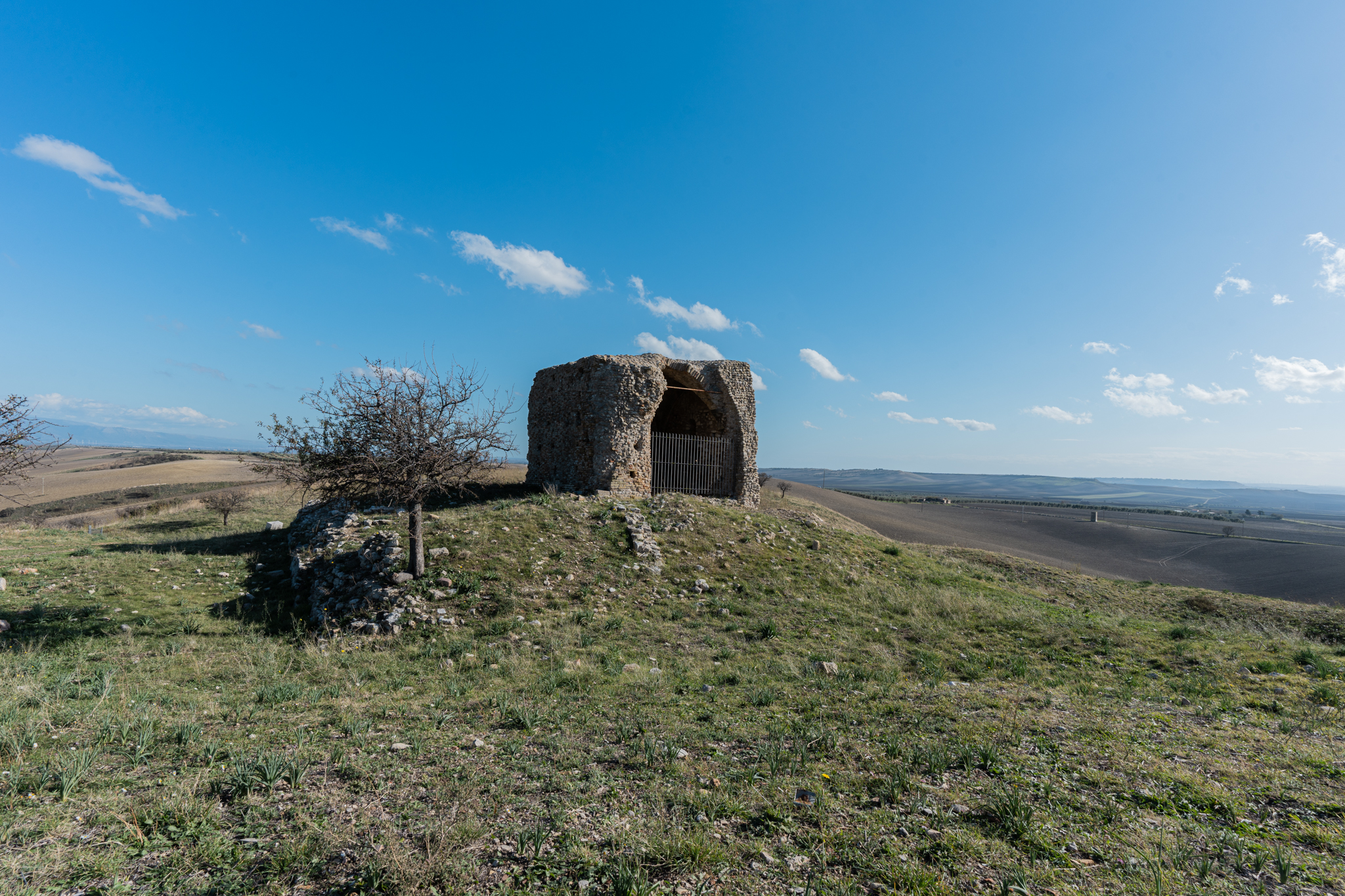
torre, Torre est del sistema di fortificazione di Catelfiorentino
This tower was once a node in the defensive system of Castelfiorentino, a Byzantine foundation in northern Apulia built to check Lombard expansion. What remains is the lower storey, revealed by excavation: a ground-floor chamber covered by a brick cross-vault resting on stone corner corbels. The base is a broad, truncated-pyramidal plinth of three well-cut stone courses, once encircled by a ditch. Above this, the wall face is of regular clay brick courses, bordered by an elegant moulded cornice. The west wall is entirely torn open, but the south wall preserves a small, intact splayed single-light window. The tower’s original height is unknown; only this lowest level survives. It was part of a fortification system built between the 11th and 12th centuries, remodelled and strengthened in the 13th, the period that linked the settlement to the name of Frederick II. The ruin is a quiet, precise fragment of medieval military architecture.
Description via source. Coordinates and heritage data from the Atika atlas.