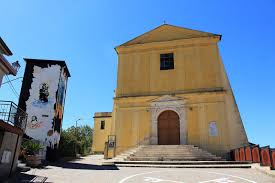
santuario, "in perpetuum", Santa Maria Assunta (Madonna della Luce)
In a pre-Silano village, the Santuario di Santa Maria Assunta (Madonna della Luce) stands as a Norman-era church whose origins are bound to a luminous legend. Local tradition holds that on the night of 8 September 970, an ancient fresco of the Madonna della Luce was discovered in a pit that emanated light, at a site called Peseca, a work hidden by Christians fleeing Saracen raids.
The church itself was built in 1064, originally dedicated to Saint Peter. Reconstructed in the 16th century upon its original perimeter walls, it has been remodelled several times over the centuries. Today, a staircase leads to the main facade of pale stone, where a round-arched entrance portal is flanked by carved angels on either side of the keystone. In 1970, marking a millennium of devotion, the Madonna was crowned with goldwork by the jeweller Gerardo Sacco, who set two rubies at the crossing of the crowns. This is a sanctuary shaped as much by stone as by story.
Description via source. Coordinates and heritage data from the Atika atlas.