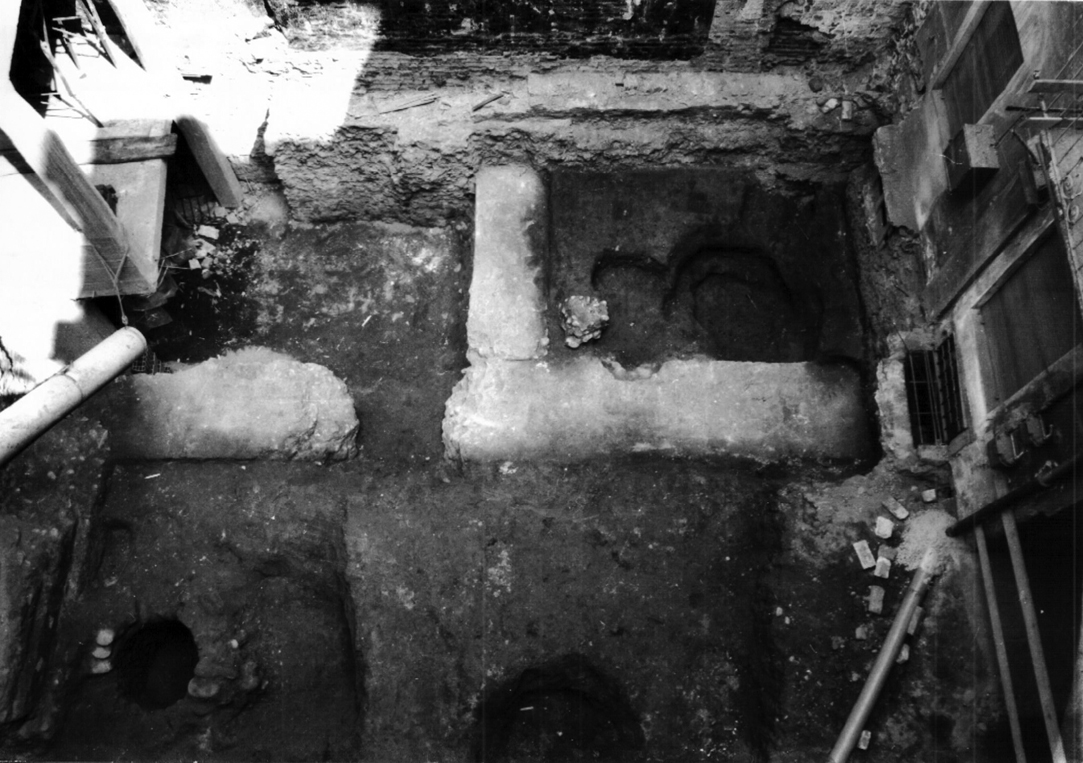
RESTI DI EDIFICIO ROMANO CON STRUTTURE SOVRAPPOSTE DI DIVERSE FASI CRONOLOGICHE
In the heart of Novara, excavations have peeled back the city’s skin to reveal a palimpsest of stone and mortar. Here, beneath the modern pavement, lie the remains of at least three distinct building phases, spanning from the late Roman period through the medieval centuries. The earliest structure, a substantial wall of river-cobbles bound with mortar, once belonged to a sizeable Roman building, its mosaic floors long since vanished but attested in earlier digs nearby. Later, a perpendicular wall was added, and then a slightly off-axis structure, perhaps a sign of shifting priorities or property lines. Above this, a medieval phase appears: a crude, trapezoidal staircase of cobbles and rough brick, leading nowhere now but once a functional step, and a circular well, its depth still unexplored. The whole deposit was sealed by a layer of burnt brick and tile, the silent evidence of a fire that brought one chapter of this site to a close.
Description via source. Coordinates and heritage data from the Atika atlas.