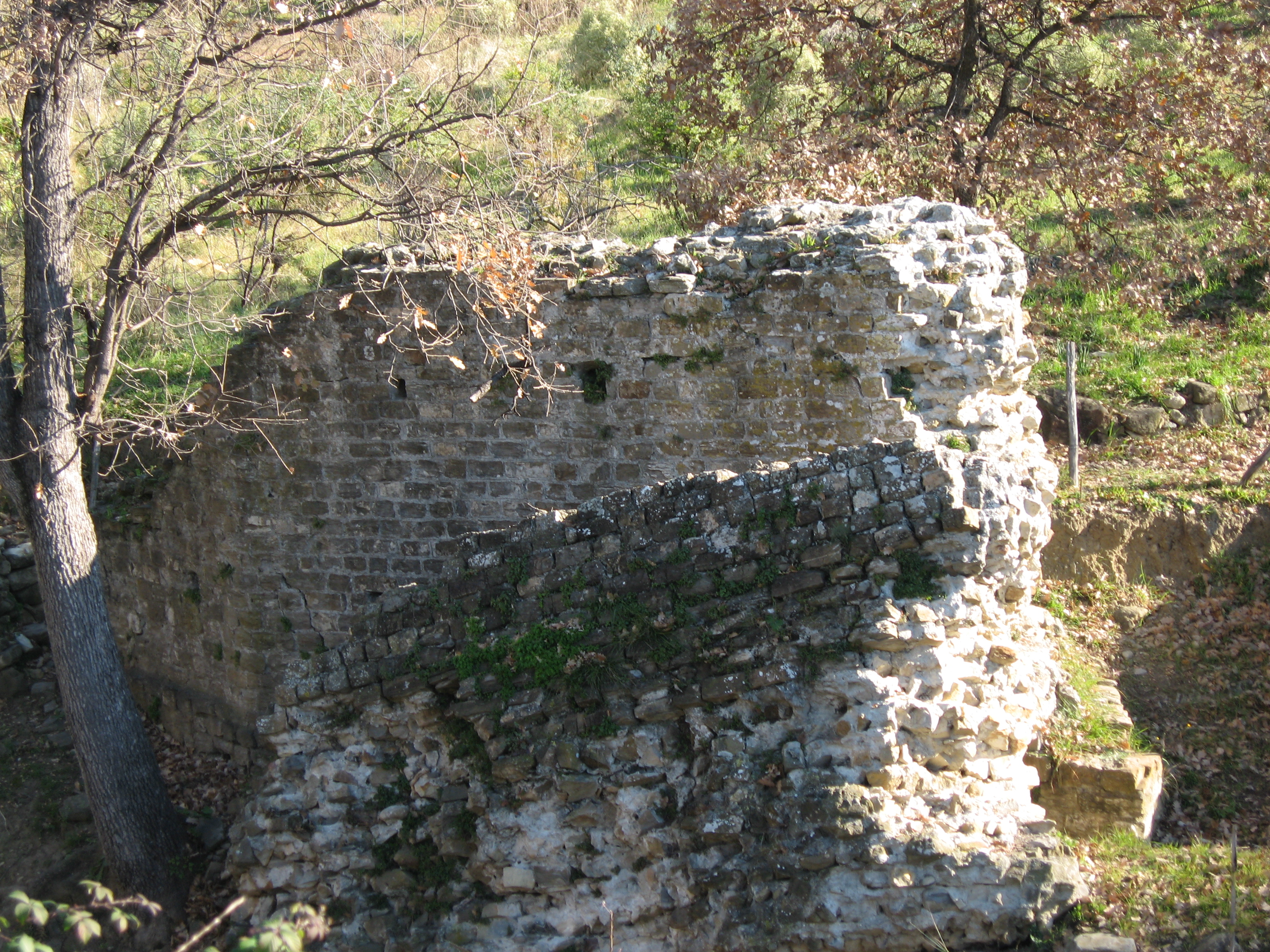
Ponte romano sul Rio della Torre
In the Fundus Porcianus, along the course of the Rio della Torre, stand the remains of a large Roman bridge, now reduced to a ruin. One pier, facing upstream, still stands; the other has collapsed and leans against the first. First noted in 1882, when it was reported to Girolamo Rossi, the structure has since been studied for its masonry technique.
The builders used a double facing of local sandstone blocks, with a core of unworked stone mixed with lime mortar. The facing is petit appareil: small, split or roughly shaped blocks laid in straight courses to create a regular, neat texture. The stone is a fine-grained siltite, its natural cleavage providing precise bedding planes. Blocks are about 10 cm high and 15-30 cm long, with mortar joints roughly 2 cm thick. Not all stone contours are visible, some covered by moss and time. A solid, workmanlike relic of Roman engineering, now quietly subsiding into the landscape.
Description via source. Coordinates and heritage data from the Atika atlas.