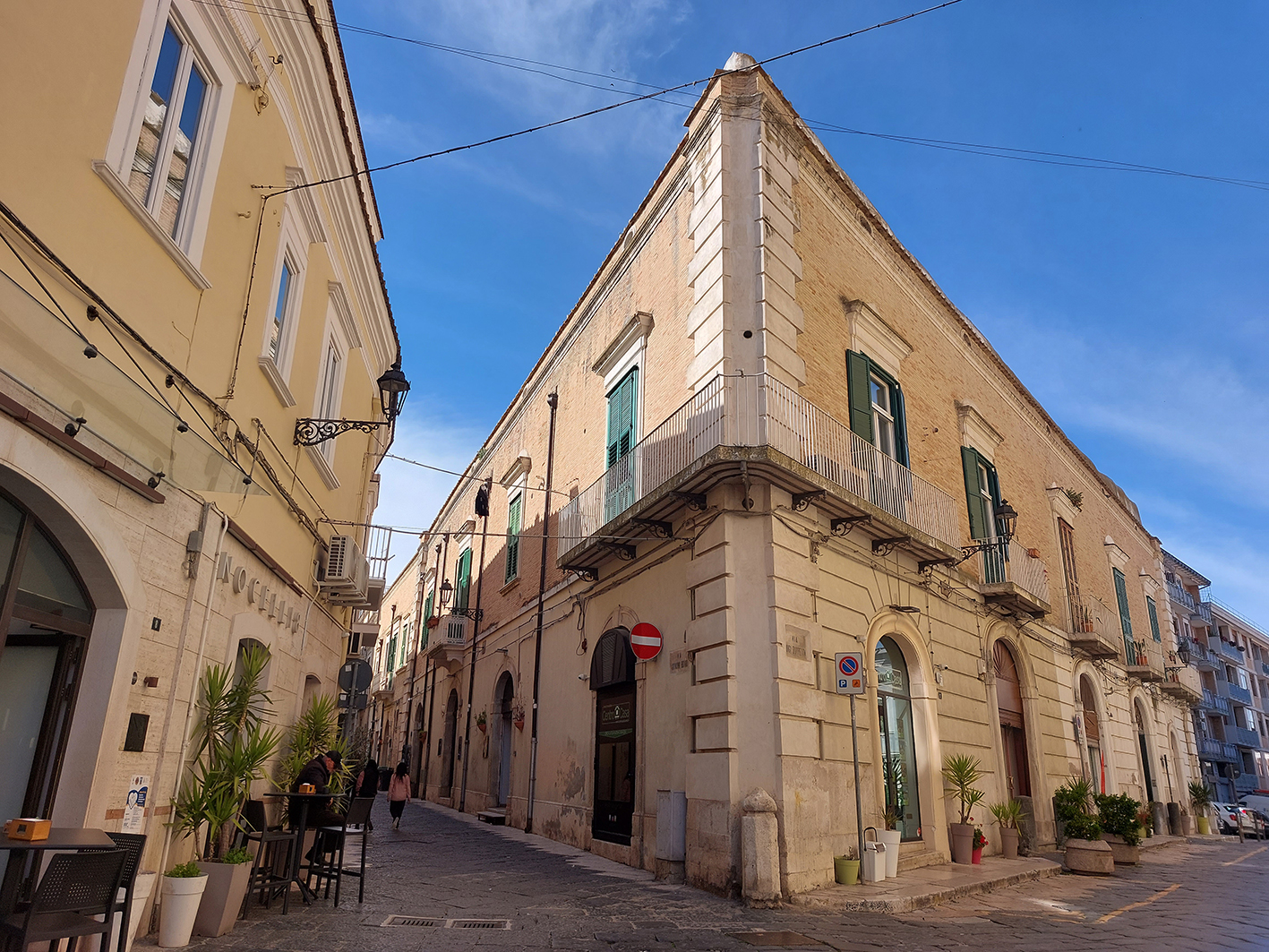
Palazzo Uva
On Via Zuppetta, Palazzo Uva presents a sober, dignified face to the street. The ground floor is dressed in rusticated stone, with five round-arched portals, the two outer ones lower than the central trio, their keystones and impost blocks projecting with quiet assurance. Above, the first floor is of exposed brick, its French windows opening onto iron-corbelled balconies; corner balconies visually tie the façade to the side wings, which repeat the same architectural motifs.
The real theatre, however, is the inner courtyard. A shallow barrel-vaulted passage, its lunettes resting on corbels, leads to a scenographic space. An eighteenth-century staircase rises through a triple arcade of shallow arches, each keystone decoratively carved, a motif echoed in the loggia’s groin-vaulted ceiling. At the base of the second-order pilasters, shell motifs and two family coats of arms appear.
Inside, frescoes survive: in the gallery, an Aurora; in the pink room, a Primavera, putti, landscapes, and a woman suspended against a blue sky, a swallow perched on her fingers, a golden ear of wheat in her left hand. From here, the yellow room and the next await.
Description via source. Coordinates and heritage data from the Atika atlas.