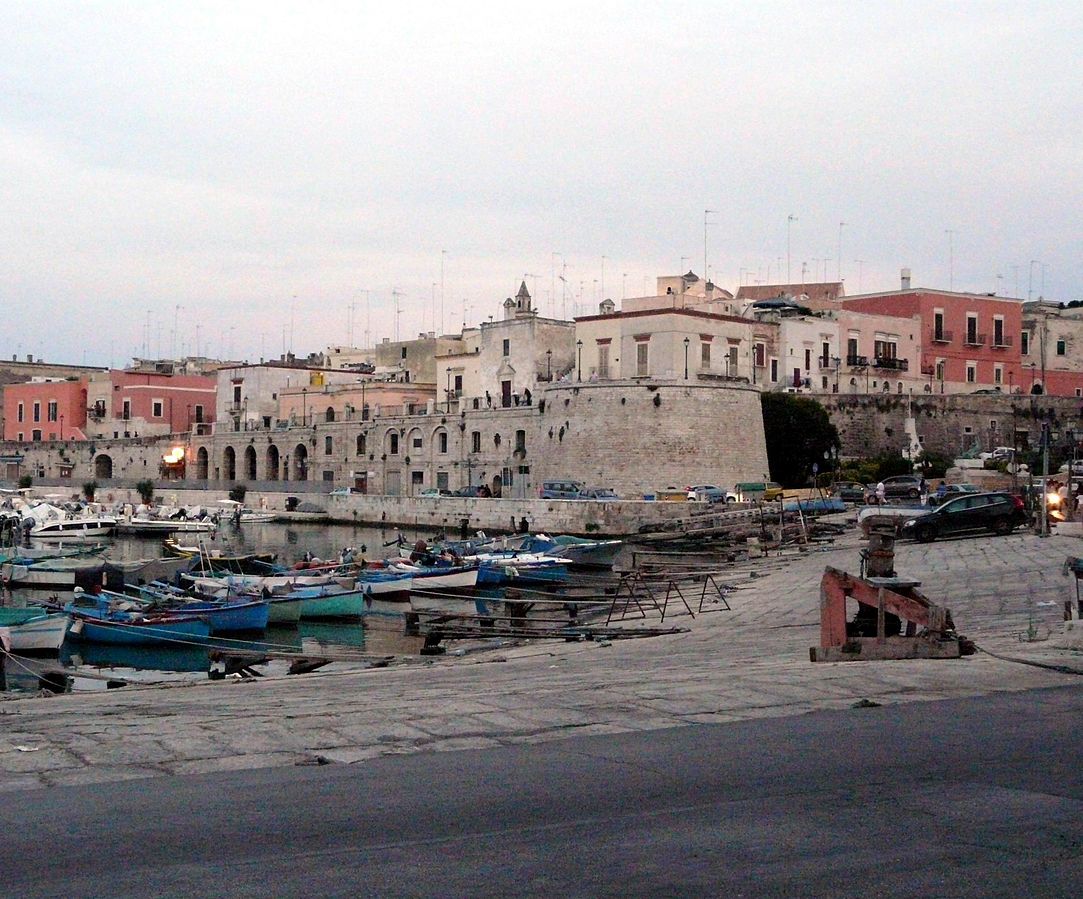
nucleo storico, costiero, portuale, difensivo, Bisceglie, casale di Vigiliae (denominazione storica, VIII sec.), Bisceglia (denominazione storica, cit. 1806)
The oldest part of Bisceglie, this coastal historic centre began as the Byzantine casale di Vigiliae in the eighth century, a watchful settlement on an already-ancient coastline. Its medieval bones were fleshed out in the Norman period, when the territory was granted to Count Pietro I, and the village assumed properly urban form. A formidable circuit of walls went up, and with them the religious and civic architecture that still defines the place.
The Normans left their mark in the three great towers of the castle, raised in 1060, and in the cathedral, built between the eleventh and thirteenth centuries, though substantially remodelled after an eighteenth-century earthquake. Later centuries added Aragonese ramparts and a procession of palazzi with rusticated stonework, stone balconies, sweeping staircases and frescoes. The churches of San Matteo, Sant’Adoeno and Santa Margherita complete a dense, layered historical fabric. This is not a museum-piece centre, but a living palimpsest of stone, sea and power, its streets still holding the shape of a frontier town.
Description via source. Coordinates and heritage data from the Atika atlas.