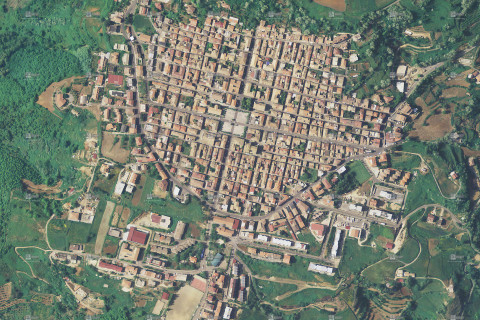
centro storico, pianificato, Filadelfia, Castelmonardo (denominazione storica, XVIII secolo), Castro Manardi (denominazione storica, XIV secolo), Castel Menardo (denominazione storica)
In 1783, a devastating earthquake levelled the old settlement of Castelmonardo. The survivors, gathered on the Piano della Gorna, did not merely rebuild; they reimagined. Their new town, given the auspicious name Filadelfia, ‘brotherly love’, was to be a physical manifesto of Enlightenment ideals, a fresh start sealed by a pact between all social classes. Its coat of arms shows two clasped hands, one gloved.
The grid they laid out is a perfect, rational square. A central piazza anchors a Greek cross of four identical quadrants, each bisected by the classical axes of cardo and decumanus, terminating in four gates. Within this rigidly egalitarian template, only the size of one’s plot varied by social rank. In each of the four quarters rose a church: Santa Barbara, San Teodoro, San Francesco, and the Madonna del Carmine. The very name was proposed by Giovanni Andrea Serrao, a deliberate echo of universal fraternity. Filadelfia is a rare, intact vision of a late-Enlightenment utopia, etched in stone and civic pride.
Description via source. Coordinates and heritage data from the Atika atlas.