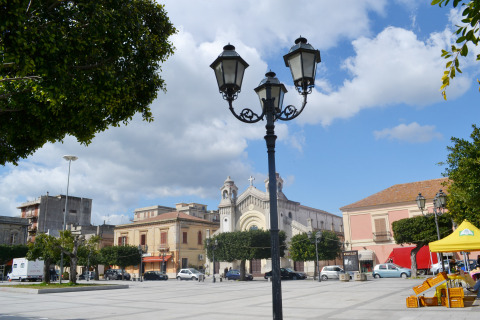
centro storico, di pianura, pianificato, a scacchiera, Locri, Gerace Marina/ Neolocri (denominazione originaria, fino al 1934)
Locri’s modern centre is a study in rational order: a chessboard grid of orthogonal axes, laid out on the plain. This is not an ancient palimpsest but a deliberate, late 19th-century creation, born when the coast was repopulated after centuries of abandonment. The original settlement, Gerace Marina, took its name from the medieval hill town inland, whose inhabitants had fled the malarial plains and Saracen raids. The railway’s arrival changed everything.
The architecture matches the town’s confident, planned character. Representative 19th-century buildings line the grid: the Church of Santa Caterina, dating from 1843, was the first local place of worship; the Neoclassical town hall, built in 1880, is a formal civic statement. Among the historic palazzi are the Teotino-Nieddu del Rio, one of the earliest, and Palazzo Scaglione, which once housed the first local archaeological collection. These buildings speak of a town that, after a long hiatus, deliberately chose to rebuild its connection to the sea, and to its own ancient Greek roots, just along the coast.
Description via source. Coordinates and heritage data from the Atika atlas.