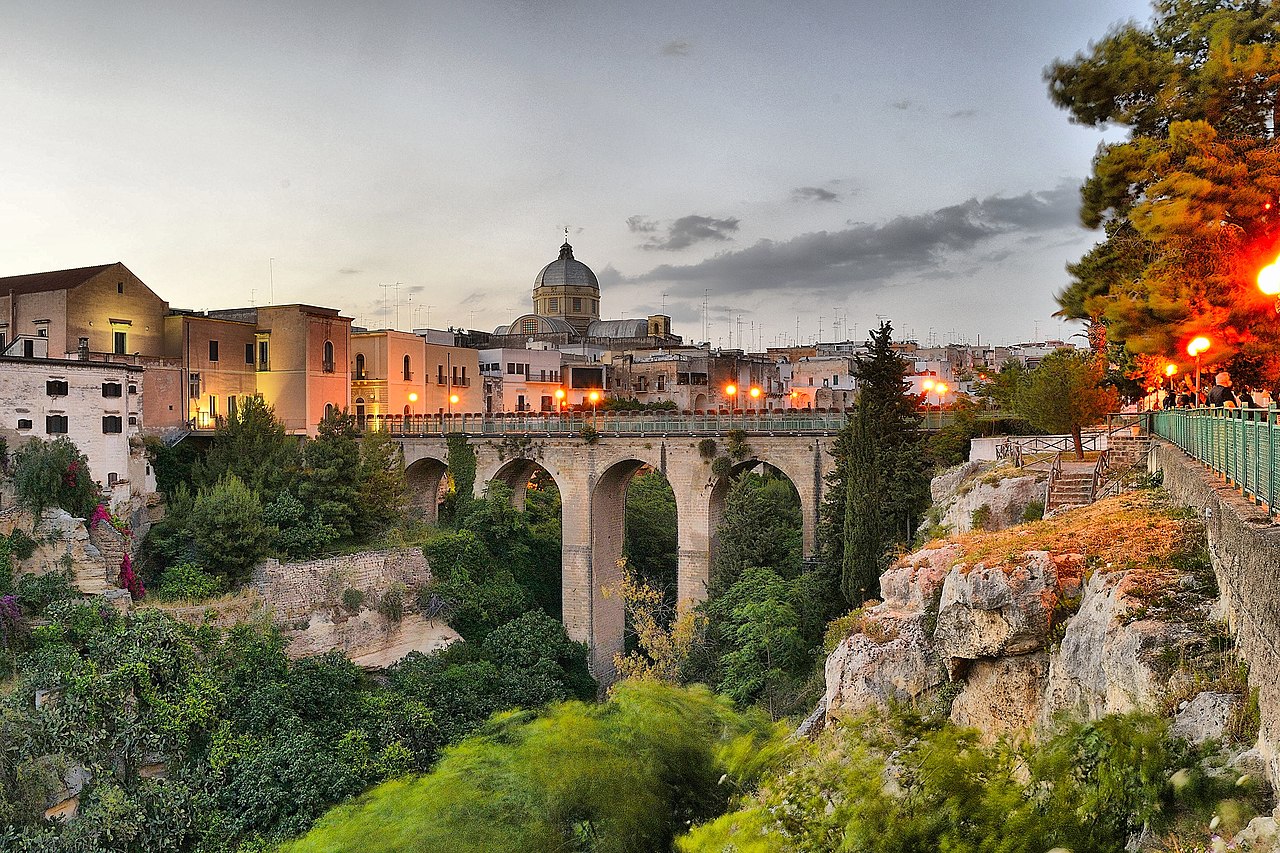
centro storico, di pianura, Massafra
The Gravina di San Marco is the deep ravine that splits Massafra’s historic centre in two: the ancient quarter known as ‘la terra’, a tangle of narrow lanes, and the nineteenth-century Borgo Santa Caterina. The ravine itself is named after the sixth-century rock-cut church of San Marco, the best-preserved of the town’s many crypts, and the site offers abundant evidence of the ‘rupestrian civilisation’ that flourished here in the early Middle Ages. The natural karst caves were first used for dwellings, then later as places of worship.
Overlooking the gravina is Massafra’s castle, first mentioned in a Lombard document of 970. It follows the typical Apulian plan: a quadrilateral fortress with four corner towers, three round, one octagonal. The original medieval nucleus is an irregular warren of streets, sheltering the sixteenth-century Chiesa Madre di San Lorenzo, built atop an earlier crypt. Elsewhere in town, the seventeenth-century churches of the Madonna di Tutte le Grazie and Sant’Agostino, the Duomo dell’Immacolata Concezione, and the church of Santi Medici all repay a quiet visit.
Description via source. Coordinates and heritage data from the Atika atlas.