centro storico, di mezzacosta, collinare, Pentedattilo, Pentadáktylos (denominazione storica), Pentedactili (denominazione storica), Pentedattolo (denominazione storica)
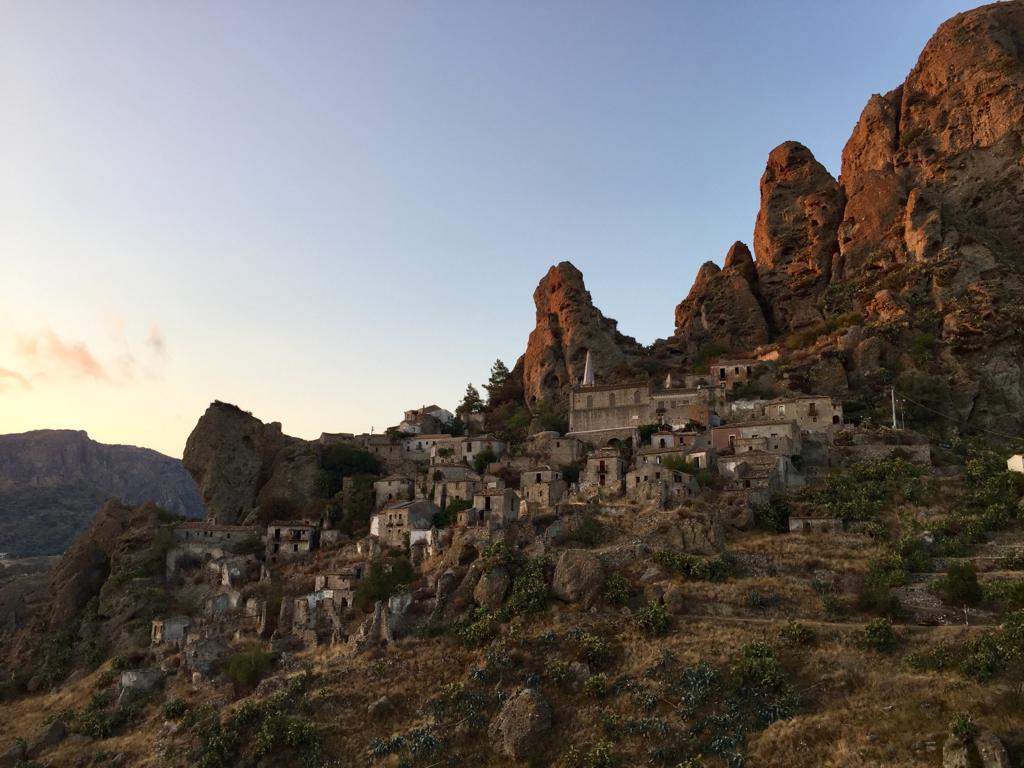
Above the Ionian coast, the abandoned village of Pentedattilo clings to a steep hillside, its name, from the Greek pentadáktylos, meaning ‘five fingers’, a nod to the jagged rock formation that looms above it. The settlement is entirely uninhabited today, yet its beauty lies precisely in this silence and its dramatic landscape context. The urban fabric follows the contours of the slope, simple one- or two-room houses arranged in terraced rows, their layout dictated by the terrain rather than any formal plan. This primitive cellular style, aggregated over centuries, gives the whole a curiously organic, almost geological feel.
First mentioned in a tenth-century saint’s life, Pentedattilo was probably founded by refugees from a Roman settlement near Melito after the Empire’s collapse. Conquered by the Normans in the eleventh century, it later boasted a defensive castle, little more than scattered wall fragments remain today. A curious record survives: an eighteenth-century fresco in Villa Caristo, at Stignano, depicts the fortress as it once stood, when Pentedattilo belonged to the Clemente family.
Description via source. Coordinates and heritage data from the Atika atlas.