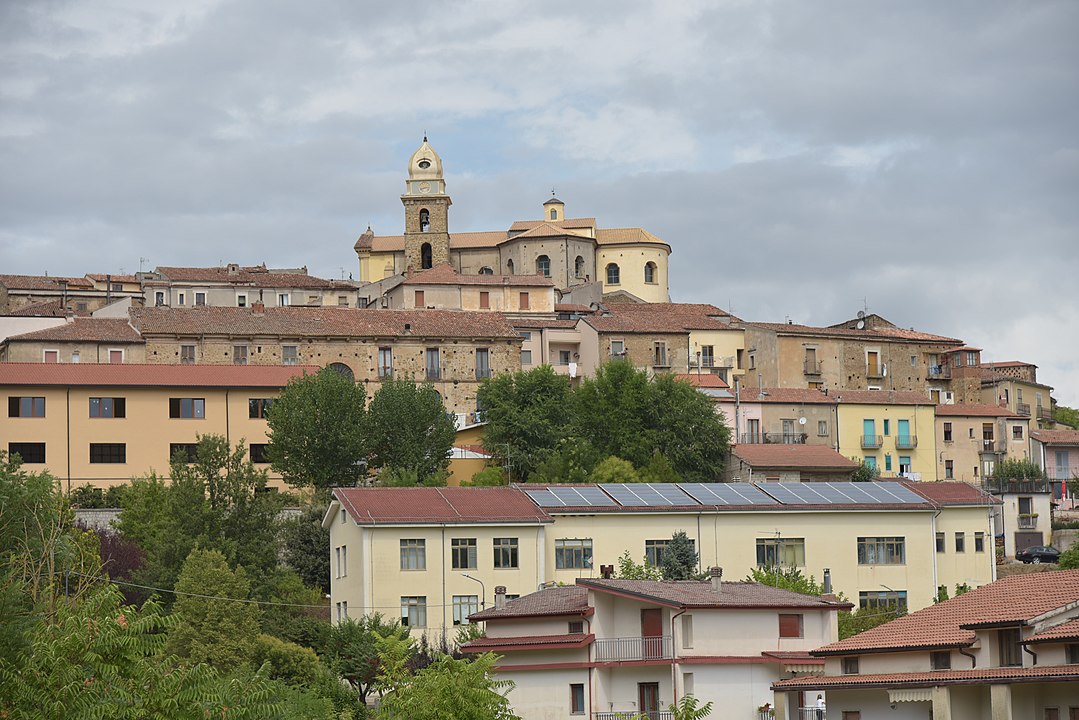
centro storico, di crinale, Spinoso
The hilltop village of Spinoso, its layout typical of a mountain settlement, unfolds along a high ridge. Its historic core is a quiet anthology of local stone and brick, where the facades of 18th and 19th-century palazzi are punctuated by the grand portals of pale local stone, known as pietra di Padula.
Piazza Plebiscito is the formal heart, where the neoclassical Palazzo delle Colonne stands alongside Palazzo Romano and the 18th-century Palazzo Ranone, now a venue for exhibitions and literary events. Elsewhere, on Corso Garibaldi and the side streets, a series of noble houses, Mileo, Robortazzi, Caputo, Delfino, each contribute a distinct note, their stone doorways and internal courtyards speaking of a measured, provincial grandeur.
The mother church, Santa Maria Assunta, follows a Latin-cross plan with a central dome, while nearby, the church of San Rocco del Popolo is a simpler, single-nave structure, its barrel-vaulted ceiling borne by the same local stone that defines the town. Founded in the Middle Ages, Spinoso’s story is the familiar one of southern Italy, passing through the hands of feudal lords, the Sanseverino, the Colonna, the Spinelli, each leaving their mark, but none quite so pervasive as the stone itself.
Description via source. Coordinates and heritage data from the Atika atlas.