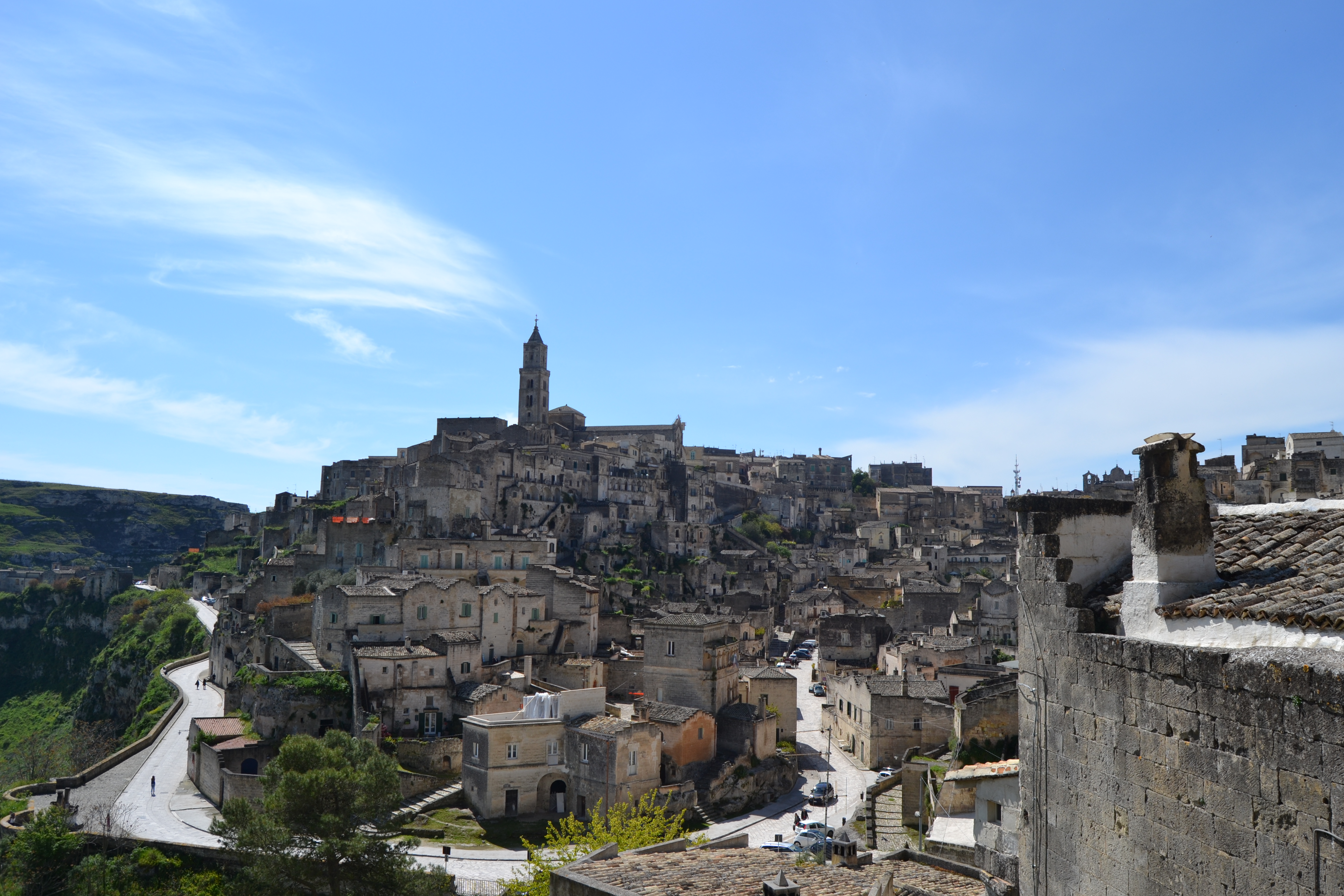
centro storico, di crinale, collinare, agricolo, Matera
The old town of Matera is not so much built as excavated. Its historic core is divided into two sassi, the Caveoso and Barisano quarters, along with the Civita and the Piano, a cultural landscape recognised by UNESCO for its vernacular, near-unbroken habitation since prehistory. Most dwellings are rock-cut architecture, carved directly into the limestone of the Murgia plateau. Roof gardens and vegetable plots perch above the houses below, creating a dense, layered tangle of built space and urban life.
The city of stone has been inhabited since the Palaeolithic; some artefacts date to the thirteenth millennium BC, and many of the houses, burrowing deep into the gravina’s calcareous rock, were lived in continuously from the Bronze Age until the 1950s clearance. After the Norman conquest of 1064, the settlement consolidated on its rocky spur above the Gravina ravine. Scattered across the Parco delle Murgia are several rock-cut churches, one of which contains the oldest known depiction of Adam and Eve’s expulsion from Eden.
Description via source. Coordinates and heritage data from the Atika atlas.