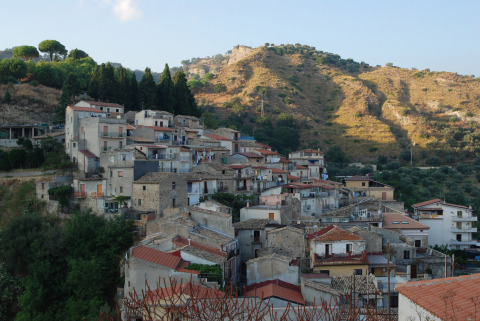
centro storico, costiero, collinare, difensivo, Gioiosa Ionica, Geoliosa (denominazione storica), Geliosa (denominazione storica), Motta Giojosa (denominazione storica), Mocta Joyusa (denominazione storica), Kàstron Gelòsion (denominazione originaria)
Gioiosa Ionica’s historic centre is a study in two distinct halves, each telling a different chapter of its story. The older part, a classic Byzantine borgo, clings to a rocky spur above the fiumara. Here, the medieval castle-town layout remains legible: tight, irregular streets, long stairways, and sudden underpasses, all contained within walls that still have their gates, Porta Falsa and Porta Barletta. The buildings, haphazard and varied, huddle defensively around a 15th-century castle, as if the site’s natural contours dictated their every turn. Among them stand a 16th-century Matrice church and two 17th-century palaces, Palazzo Rodino and Palazzo Deodino.
Spread down the slope, the second area fans out from Piazza Plebiscito, where the main roads converge. Its 17th- and 18th-century layout is more orderly, with buildings aligned along clear longitudinal lines, their repeated typological forms lending the quarter a quiet homogeneity, despite later renovations. Together, the two halves map the slow, pragmatic growth of a settlement shaped by defence, terrain, and time.
Description via source. Coordinates and heritage data from the Atika atlas.