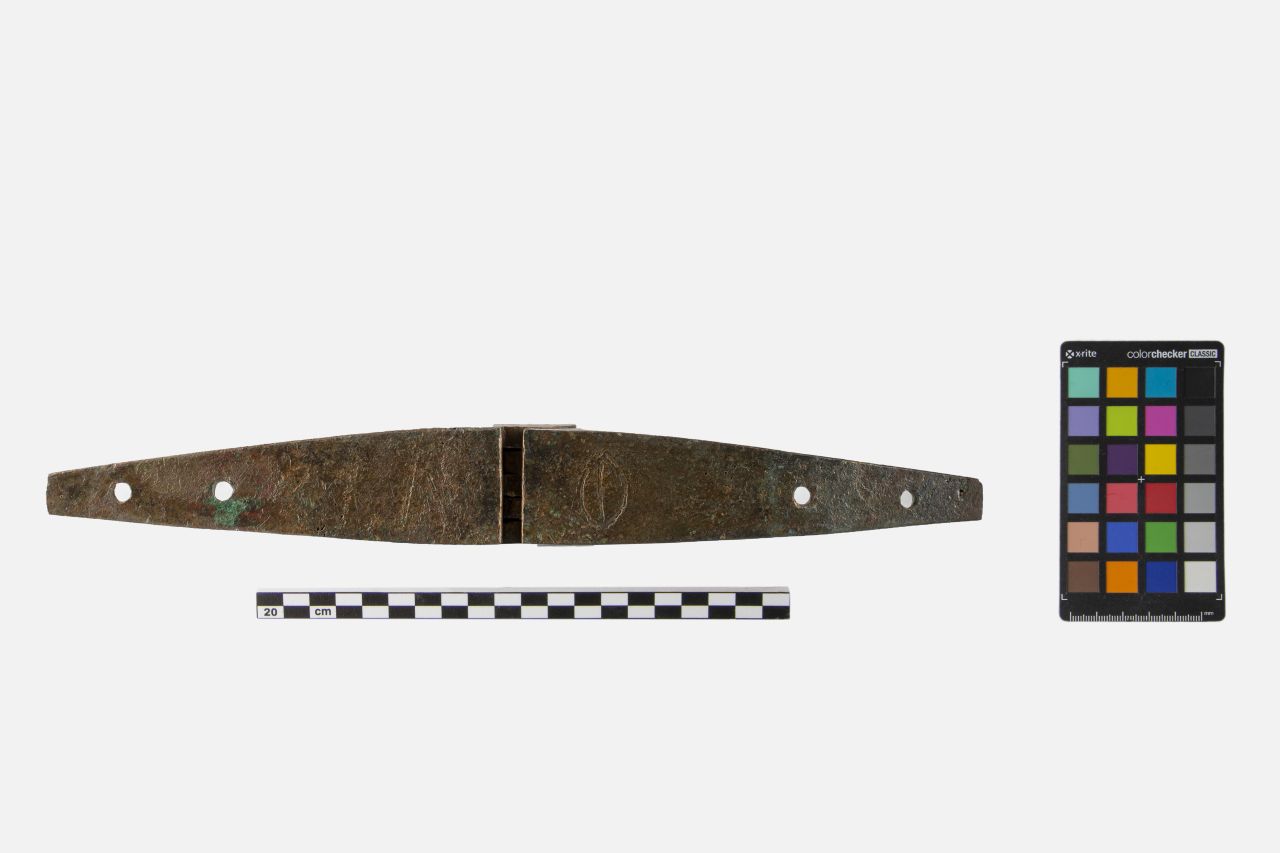
cardine/ gruppo, con cerniera
Six Roman hinges, part of a set, survive as a study in sturdy, functional design. Each is a long, trapezoidal plate with one inner edge folded into an L-shape. The hinge mechanism consists of wide cylindrical rings, which still hold faint traces of the original iron tubing and a nail. The plates themselves vary in size, though each has three profiled sides and a single large hole for a fixing nail.
A few of the plates bear stamped letters, likely an ancient assembly code. This suggests the hinges were part of a larger, prefabricated structure, perhaps a door, a chest, or a piece of military equipment, where numbered parts were fitted together on site. The workmanship is practical and robust, typical of Roman metalwork designed for longevity. These are not decorative objects, but evidence of a systematic approach to construction, where even a simple hinge was carefully planned and marked.
Description via source. Coordinates and heritage data from the Atika atlas.