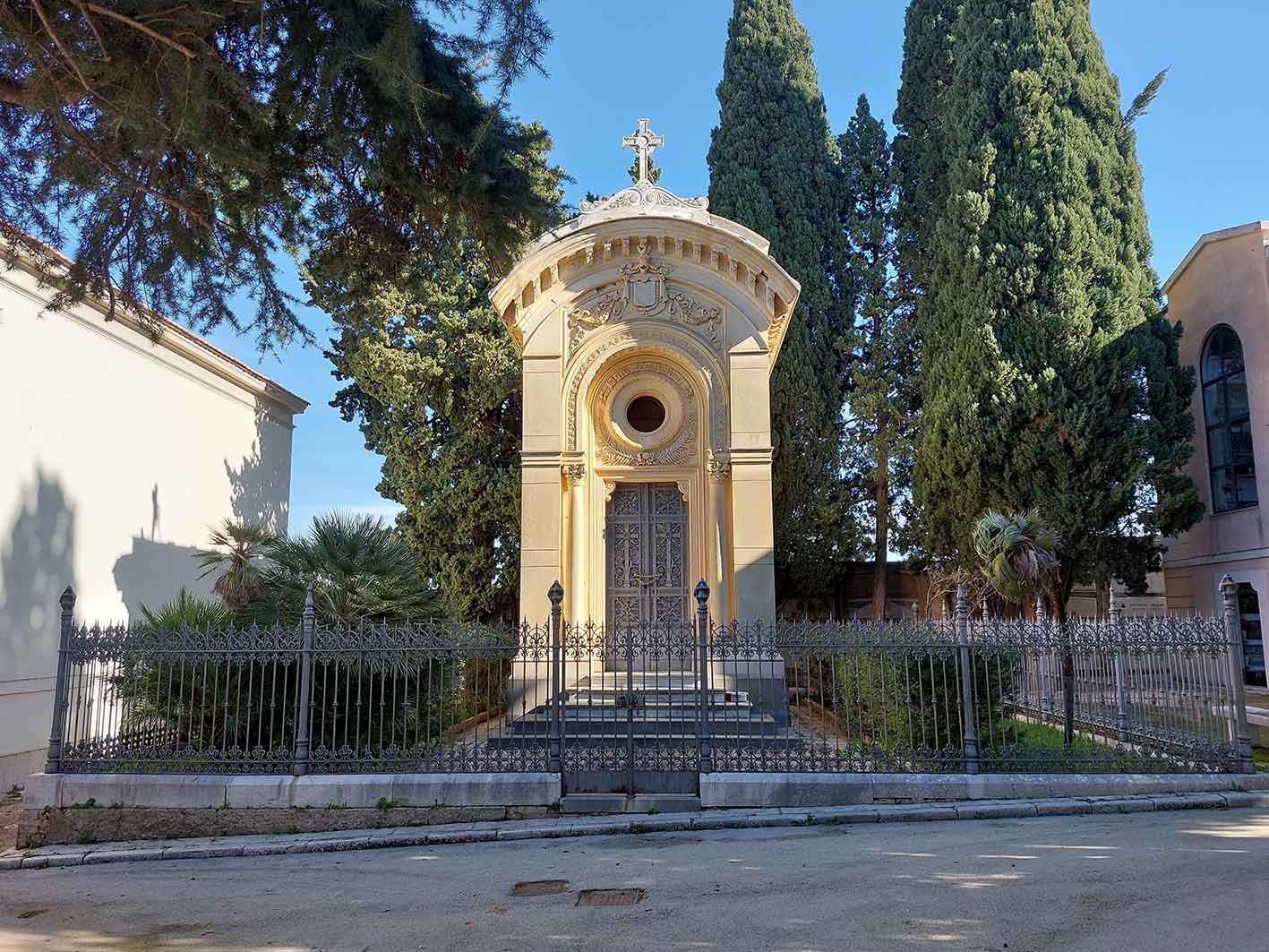
Cappella cimiteriale del Principe de Sangro
At the edge of a Neapolitan cemetery stands a curious tower, a chapel built for a prince who clearly expected an audience. The structure is square, two-storeyed, with a semi-basement, its tufa blocks rising from the ground with a certain theatrical gravity.
The facade is a compendium of symbolic gestures: a stone architrave with inward-turning volutes, a circular oculus framed by a great arch on Corinthian columns, and above it all, the noble coat of arms, topped with a skull and flanked by carved stone festoons. The message is unambiguous. The roofline is supported by decorated mutules, and the central pediment bears a Celtic cross with potent arms.
The side elevations are more restrained, with three arched openings, the central one glazed. The rear facade is simpler still, though its single arched window holds polychrome glass. Inside, the chapel is rich with Baroque stucco: Corinthian pilasters, rosettes, and allegorical frescoes in the lunettes. A corridor leads down to the crypt, behind a simple gate. A princely mausoleum, unapologetically dramatic.
Description via source. Coordinates and heritage data from the Atika atlas.