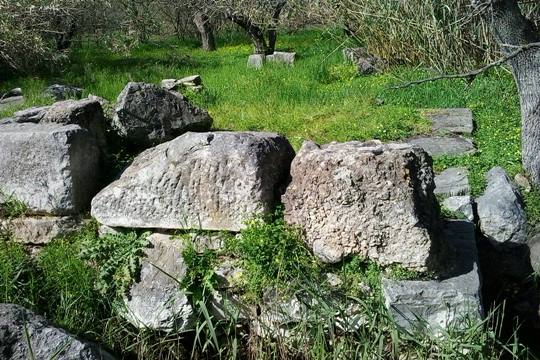
Tropaio
Near the Great Marsh, where the Persian dead are said to have been thickest after the battle of Marathon in 490 BC, stands a scatter of ruined stone that once formed a Byzantine tower. Built in the 11th or 12th century, it had already collapsed by the 1400s, and nineteenth-century travellers noted that its masonry was largely recycled ancient blocks. In 1965, Eugene Vanderpool of the American School of Classical Studies in Athens dismantled the structure to recover an Ionian capital and column drums, which proved to be fragments of the original victory trophy raised after the battle. That work left the tower in complete ruin. Before its removal, the building measured 5.82 by 4.48 metres, was aligned to the cardinal points, and stood about a metre high at its orthostate course, with a rubble partition dividing it into two equal rooms. The genuine trophy now resides in the Marathon museum, while a replica marks the original spot.
- Kastra.eu, Castles of Greece · reference
Coordinates and heritage data compiled in the Atika atlas.