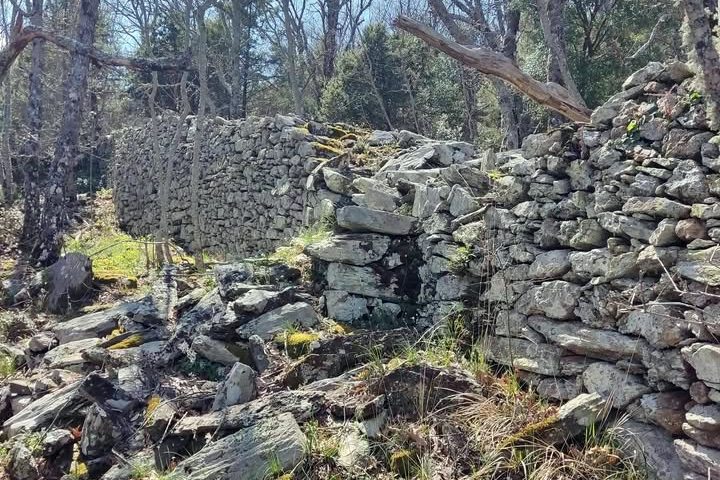
Palaiokastro-Chalkidiki
On a wooded hill east of the village of Paleokastro in Chalkidiki, north of Polygyros, stand the ruins of a castle whose origins remain stubbornly obscure. No historical record names it directly, though it may be one of the fortified refuges mentioned in a 996 document from the Iviron monastery on Mount Athos, where local villagers sought shelter from Bulgarian attacks. The nearby mid-Byzantine settlement of Vatonia lay about two kilometres to the north. Dating is complicated by the absence of binding mortar in the masonry, but the castle most likely belongs to the Byzantine period, somewhere between the fifth and tenth centuries.
The fortification occupies roughly 4,000 square metres, protected on three sides by a wall and on the south by natural cliffs. Much of the wall has collapsed, but the eastern side survives best, standing two metres high and 1.70 metres thick. Two gates remain traceable: a larger, probably main entrance with a small exterior staircase, and a smaller one further south. Rainwater drainage holes pierce the surviving sections, and faint traces of interior building walls can still be made out within the enclosure.
- Kastra.eu, Castles of Greece · reference
Coordinates and heritage data compiled in the Atika atlas.