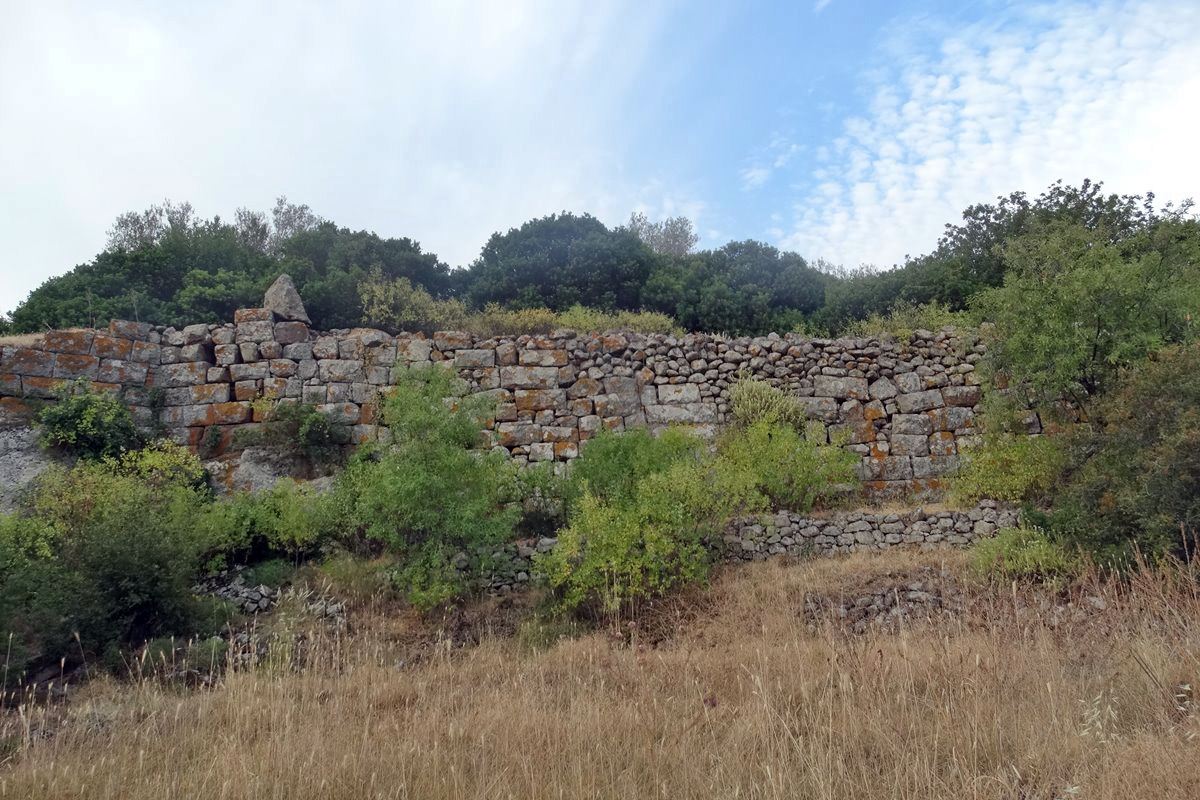
Methana
The ancient acropolis of Methana, known locally as Palaeokastro, stands on a hill south of Vathi, near the beach of Megalochori, eight kilometres west of the modern town. Its Hellenistic fortifications survive in large part, with medieval additions visible. The hill was inhabited continuously from the Neolithic era until the Tourkokratia, serving as the peninsula's principal city in classical, Hellenistic and Early Byzantine times. The acropolis walls date from the fourth to third centuries BC, built from the dark volcanic rock of the area.
The city minted its own coins from the last quarter of the fourth century BC, bearing Hephaestus's head and the horn of Amalthea with the letters ME, a nod to the local volcano. Between 270 and 145 BC, the Ptolemies established a naval base and garrison, renaming the city Arsinoe. The volcanic eruption of circa 270 BC caused major damage, prompting extensive repairs. Pausanias, visiting in the second century AD, noted sanctuaries of Isis and Serapis, statues of Hercules and Hermes, and a temple of Athena on the isthmus. Submerged ruins offshore, including Byzantine churches, suggest later geological upheaval. Early Christian basilicas, built with spolia, indicate habitation until at least the seventh century, after which Methana vanishes from the historical record.
- Kastra.eu, Castles of Greece · reference
Coordinates and heritage data compiled in the Atika atlas.