Machairado
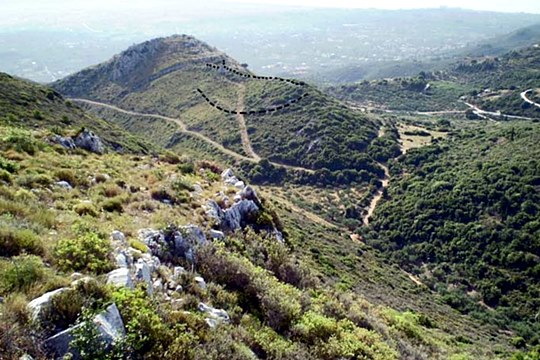
On a hilltop that had already known fortification in the 5th or 4th century BC, the Byzantines later raised a defensive work of their own. The ancient enclosure had walls roughly two metres thick, built from large, unhewn blocks, and its layout is odd: a central dividing wall runs over the summit, while a section on the south side is missing entirely. The masonry is not refined, which hints at hasty construction or an unfinished project. In the Middle Ages, a smaller fort was inserted at the hill's crown, reusing parts of the older walls but covering only a fraction of the original area. The 20th Eforeia of Byzantine Antiquities investigated the site in 1991 and dated this medieval addition to the 10th or 11th century, possibly a response to Saracene raids on the Ionian islands. No historical records or medieval artefacts survive, so the fort was likely abandoned early or never used systematically. Dense vegetation once hid the ruins, but a wildfire in 2010 cleared the slopes, leaving them far more visible today.
- Kastra.eu, Castles of Greece · reference
Coordinates and heritage data compiled in the Atika atlas.