Lachanas
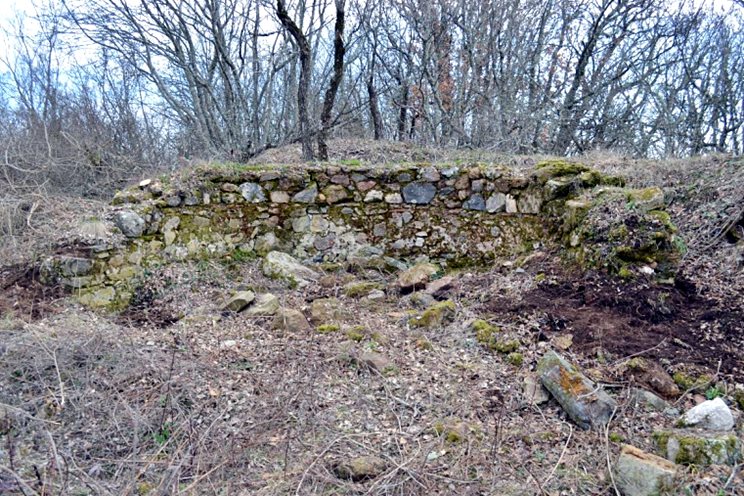
On a wooded low hill called Paliokastro, meaning old castle, about 1.5 kilometres west of Lachanas in the northern Thessaloniki prefecture, stand the few remnants of a Byzantine fortification. The hill's older name, Asar, derives from the Turkish hisar, also meaning castle. Human activity here is ancient: traces of Iron Age life and Archaic pottery have been found. The fortification itself was built in two phases. The older, perhaps 7th or 8th century, survives in three places on the east and north sides, in lengths of 8 to 12 metres and at a modest height. The later phase, probably 10th century, encircled the site; its best stretch, in the southwest, runs about 35 metres, stands 3 metres high and is a metre thick. The castle was elliptical, covering roughly 14,000 square metres within a 450-metre perimeter, of which some 80 metres of wall are visible today. A rectangular tower likely guarded the southern entrance, and a brick cross is the only surviving ceramic decoration. On the acropolis plateau, only the lower part of a semicircular niche remains from a church dedicated to the Virgin, its masonry suggesting an 8th-century date.
- Kastra.eu, Castles of Greece · reference
Coordinates and heritage data compiled in the Atika atlas.