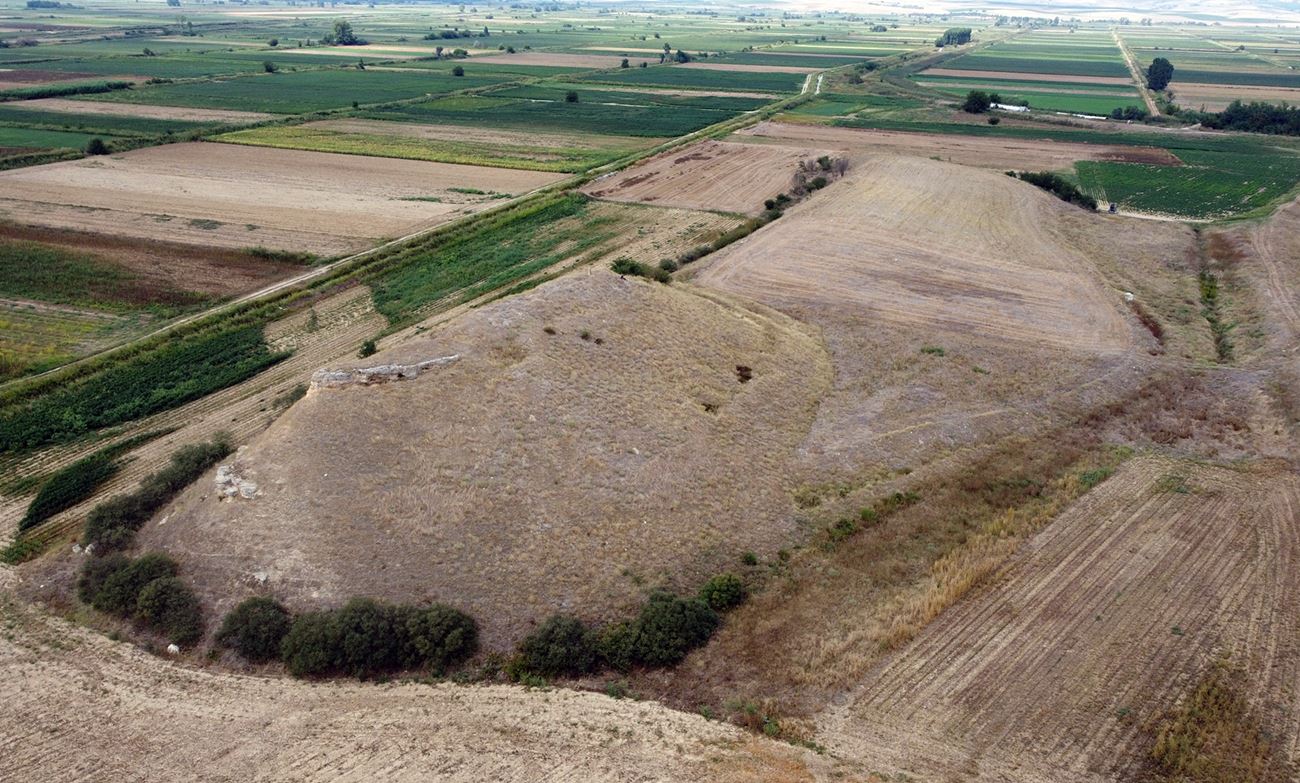
Kaisaroupolis
A low, trapezoidal hill two kilometres north-northwest of Myrkinos and four west of Draviskos in the Serres prefecture holds the faintest trace of a Byzantine city: a single stretch of wall, six metres long, nearly two thick, and rising barely two metres. This is all that remains of Kaisaroupolis, the "Caesar's town" founded in 836 by Alexios Musele, an Armenian-born general and son-in-law of Emperor Theophilus, who had just been granted the title of Caesar. His campaign against the Bulgars was, it seems, a pretext to seize the coastal strip between the Nestos and Strymon from the Slavs, and the city he raised bore his new rank. The site was once far less accessible: the now-drained Lake Achinos and its marshes surrounded the hill seasonally, and an Austrian map shows it as "Yilan Kalesi", Snake Castle. The perimeter wall ran roughly 700 metres, but drainage works in the 1930s quarried the stone away. A lead seal of an eleventh- or twelfth-century Bishop Agapios confirms the see; the city appears in the Alexias as an exile spot, and in 1454/55 an Ottoman register lists some 79 inhabitants.
- Kastra.eu, Castles of Greece · reference
Coordinates and heritage data compiled in the Atika atlas.