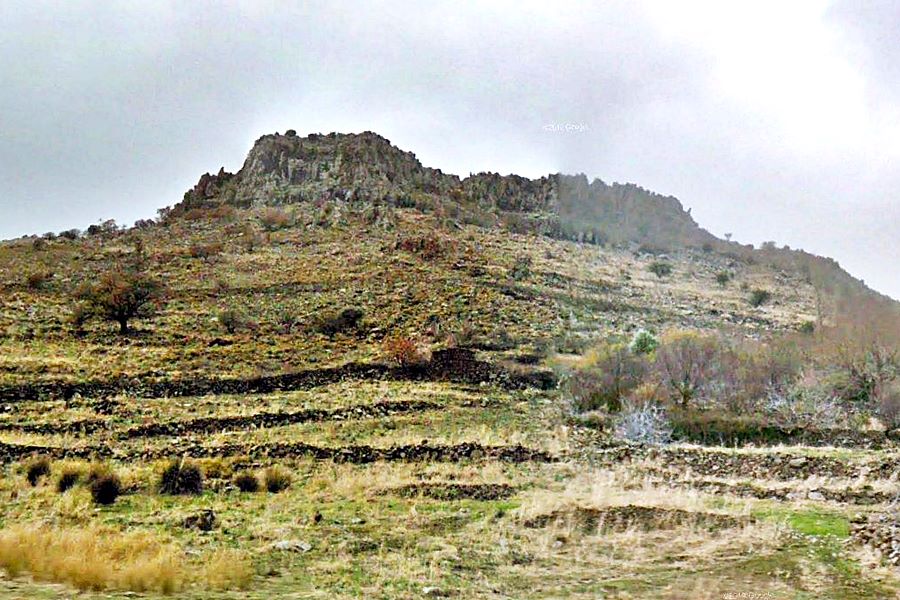
Chalandrokastro
Chalandrokastro is a ruined medieval fortification on a rocky hill about two kilometres southwest of Agra in Lesvos, close to the road to Mesotopos. Its date is uncertain, but it resembles other undated, ruined castles in the island's interior, such as Agiasos and Stypsi. These strongholds, absent from historical records, appear to have been raised in the mid-Byzantine period, probably during the Dark Ages (7th to 9th centuries), when Saracen and other pirates harried the Aegean. They remained in use at least into the Genoese Gatelouzi era (1355-1462), and Chalandrokastro likely dates from the 7th to 10th century, supported by abundant mid-Byzantine pottery finds. Earlier habitation is evidenced from the Early Bronze Age and classical antiquity. The castle probably served until the Gatelouzi period, when the local alum trade flourished, then was abandoned, likely early in Turkish rule, once coastal raiding ceased to threaten inland routes.
The fortification occupies a narrow plateau, 180 metres long and 40 wide, aligned northeast-southwest, atop cliffs. It overlooked Kontisia, a medieval settlement of 118 houses, now vanished, where alum was mined. A section of the eastern wall survives: two metres thick, built of cobblestones and mortar. Other sides show traces, though the steep rocks likely provided sufficient natural defence. In the plateau's centre lie remains of a large cistern, 9.16 by 5.61 metres and 2.5 metres deep.
- Kastra.eu, Castles of Greece · reference
Coordinates and heritage data compiled in the Atika atlas.