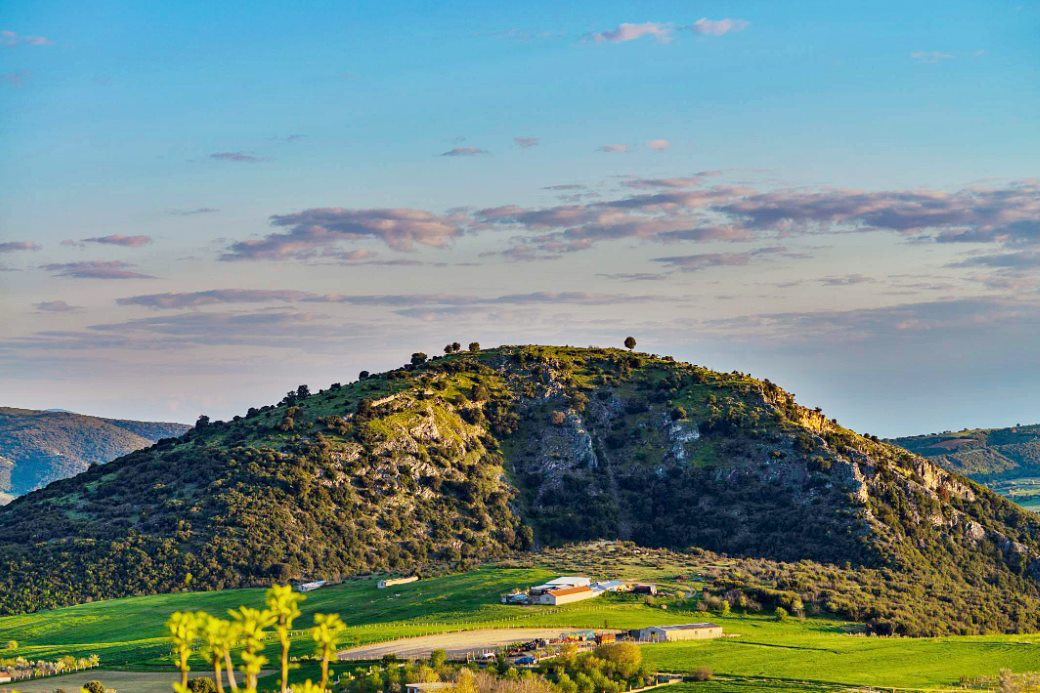
Azoros
The ancient city of Azoros, the best fortified of the three towns that made up the Perraivian Tripolis in northern Thessaly, sits south of the modern village of the same name, on the east bank of the Sarantaporos River. Its hilltop acropolis, known as Kastri, was inhabited from the Stone Age right through to the seventeenth century, and its defences survive in an unusual triple enclosure. The outer circuit is visible only at foundation level; the middle wall, partly built in the third century BC of limestone with protruding square towers, also contains a fifth-century section in pseudo-isodomic masonry some 47 metres long; the inner circuit uses small, unhewn stones without towers. A shared northern wall, 5.5 metres high and 100 metres long, crowns the steepest side. Byzantine repairs, identifiable by mortar, appear in places, and within the acropolis stand the ruins of a three-aisled basilica, 18.8 by 12 metres, with marble paving and a mosaic floor substructure. The city is mentioned by Livy, Polybius and Strabo, though its name supposedly derives from the helmsman of the Argo.
- Kastra.eu, Castles of Greece · reference
Coordinates and heritage data compiled in the Atika atlas.