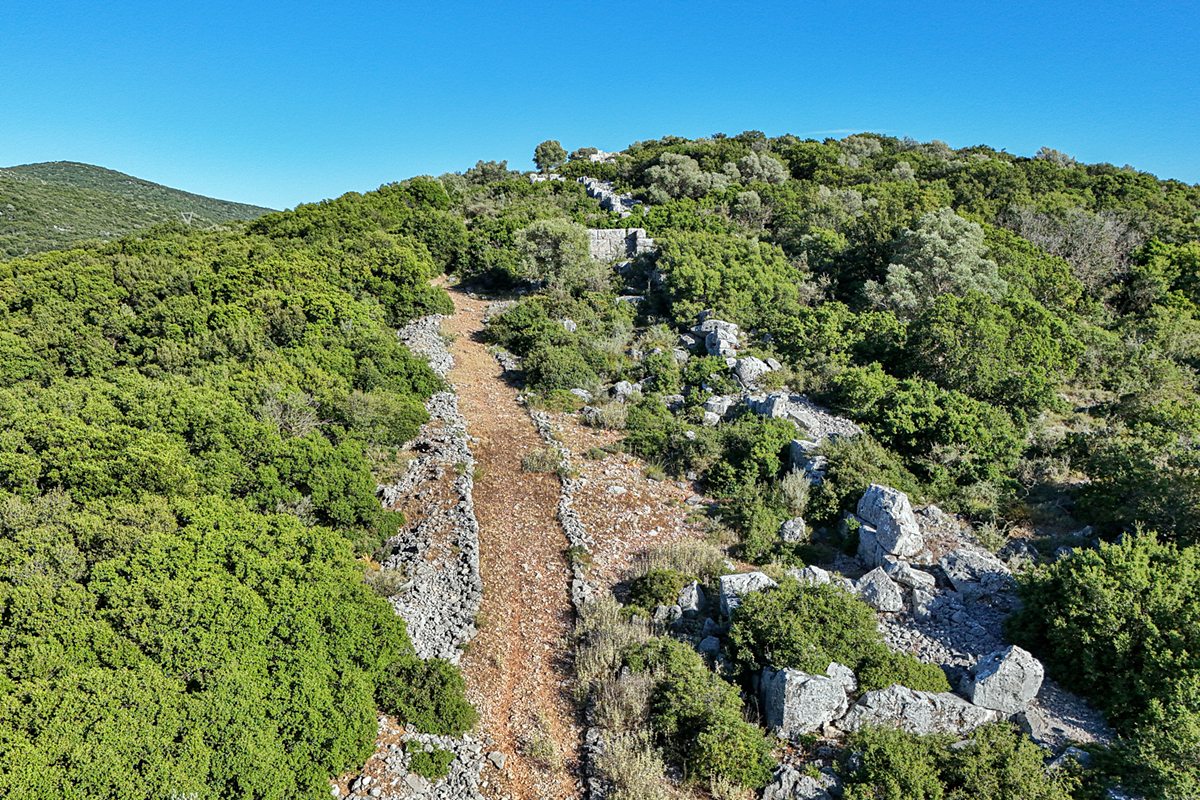
Ancient Krani
The ancient citadel of Krani occupies two hills above the southeastern edge of the Cutavos lagoon, just east of Argostoli. The eastern hill, Pezoules, and the slightly lower western hill, Kastelli, both carry ruins of the ancient acropolis, with Kastelli also bearing traces of medieval fortification. The city itself spread amphitheatrically down the southern and western slopes, possibly reaching the valley and lagoon. Its name derives from a spring at the foot of Kastelli, still feeding Argostoli's water supply, which the walls descended to protect.
Krani was one of Cephalonia's four city-states, noted by Thucydides, with its own fleet and coinage. It peaked in the Hellenistic period, around the third century BC, when it joined the Aetolian League. A grand but unfinished expansion northwards survives as a 1,090-metre wall with 21 towers, 3.5 metres wide, featuring two gates, one resembling Athens' Dipylon. Earlier claims of Mycenaean origins rest only on misidentified "cyclopean" masonry. The city declined in Late Antiquity, though Kastelli was repaired in the Middle Ages to guard the Byzantine fleet's anchorage, and possibly used by the Venetians. A temple's foundations, a Roman portico, and a sanctuary to Demeter and Persephone remain.
- Kastra.eu, Castles of Greece · reference
Coordinates and heritage data compiled in the Atika atlas.